
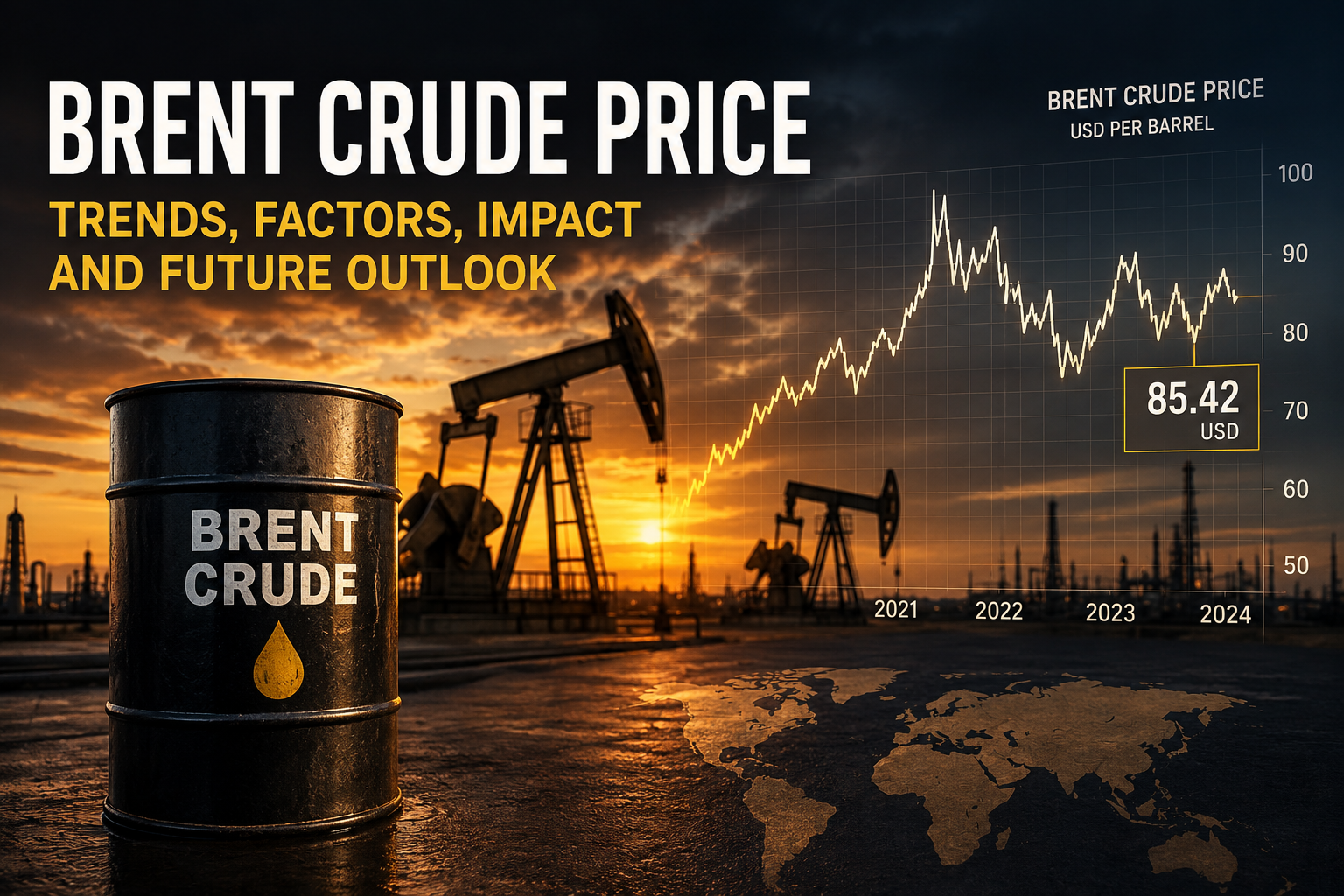
The Brent crude price is one of the most closely watched numbers in the global energy market. Whether you follow inflation, gasoline prices, airline costs, stock markets, currencies, or international trade, Brent crude eventually finds its way into the conversation. Oil may seem like just another commodity, but its price can influence almost every corner of the modern economy.
Brent crude is particularly important because it serves as a major international benchmark for crude oil. According to Intercontinental Exchange (ICE), Brent is a price barometer for roughly 80% of global crude. Its waterborne nature makes it highly useful for international trade because crude can be transported by ship to markets around the world.
The market is constantly moving, which is why searching for the brent crude price can produce a different answer from one hour to the next. Prices respond to supply and demand, geopolitical developments, refinery activity, economic growth, inventories, currency movements, OPEC+ decisions, shipping conditions, and expectations about the future.
As of August 7, 2026, Brent prices have been trading above the $83-per-barrel area in reports published today, after oil rebounded from a sharp decline earlier in the week. brent crude price Recent movements have been heavily influenced by developments surrounding the United States, Iran, and the Strait of Hormuz.
That volatility is exactly what makes Brent crude fascinating—and sometimes frustrating. A trader may see a major price move based on a headline, while a consumer may only notice it later through fuel and transportation costs. Understanding the market requires looking beyond a single price quote.
This guide explains what the Brent crude price means, why it changes, how Brent differs from WTI, how geopolitics affects oil, how supply and demand interact, what Brent futures are, and how investors and businesses can interpret price movements without jumping to conclusions.
What Is the Brent Crude Price?
The brent crude price refers to the market value associated with Brent crude oil, one of the world’s leading crude-oil pricing benchmarks. It isn’t simply the price of one particular barrel sitting in one particular oil field. Instead, Brent is part of a broader pricing system used to value crude oil traded internationally.
Brent originated from oil production in the North Sea, but the benchmark has evolved considerably over time. The modern Brent pricing complex incorporates several crude streams, and ICE explains that WTI Midland was added to the Brent basket beginning in June 2023. brent crude price The broader benchmark system helps maintain its relevance as production patterns and global trade change.
The easiest way to think about Brent is as a reference point. Imagine a large international oil producer selling crude to a refinery thousands of miles away. The buyer and seller need a transparent market reference to help determine a fair price. Brent can serve as that reference, with adjustments made for the quality, location, transportation cost, and other characteristics of the particular crude being traded.
That is why the Brent crude price can affect crude grades that are not literally Brent crude. Pricing formulas for many internationally traded oil grades are linked directly or indirectly to major benchmarks.
The benchmark also has a strong connection with physical oil markets. ICE says its Brent Index is calculated from qualifying transactions and assessments in the North Sea physical market and is used as the final cash settlement price for the expiring front-month Brent futures contract.
So, when someone says that Brent is trading at a certain price per barrel, they are talking about a benchmark with a much broader role than the value of a single cargo.
Why Brent Crude Is So Important to the Global Economy
Oil remains a fundamental input for transportation, manufacturing, chemicals, logistics, aviation, construction, and many other industries. That gives the brent crude price an unusually broad economic impact.
Consider transportation first. Crude oil is refined into gasoline, diesel, jet fuel, marine fuels, and other petroleum products. When crude prices rise substantially, refiners often face higher input costs. Depending on refining margins, taxes, local competition, inventories, and currency movements, some of those costs can eventually reach consumers.
Transportation costs can then influence the prices of other products. Trucks move food and manufactured goods. Ships carry raw materials and finished products. Airlines consume large quantities of jet fuel. Construction companies use fuel for heavy equipment. Higher energy costs can therefore spread through supply chains.
Oil prices can also influence inflation expectations. A sudden energy shock can make headline inflation rise even when other parts of the economy remain relatively stable. Central banks therefore watch energy markets carefully, although monetary policy is based on a much wider set of economic data.
For oil-producing countries, the relationship works in the opposite direction. Higher crude prices can increase export revenues, government income, corporate profits, and foreign-exchange earnings. Lower prices can create fiscal pressure, especially in countries that depend heavily on petroleum revenue.
This makes Brent more than a commodity-market statistic. It is a signal that can reveal changing expectations about global economic conditions, energy supply, geopolitical risk, and future demand.
Brent Crude Price Today: Why the Number Keeps Changing
One of the most important things to understand about the brent crude price is that there is no permanent daily number. Oil trades in a highly active global market, and prices can change continuously during trading hours.
On August 7, 2026, reports showed Brent above $83 per barrel as oil prices recovered after a sharp decline earlier in the week. Fortune reported an oil price of $86.04 per barrel at 5:20 a.m. Eastern Time using Brent as the benchmark, while other reports during the day placed Brent above $83. The difference illustrates why exact price quotes depend on the time, contract, and market source being used.
This is also why people should be careful when comparing two websites. One may show the front-month futures contract, another may show a delayed quote, and another may show a spot or dated Brent assessment. These prices can be related without being identical.
Timing matters enormously in oil markets. A headline about a production disruption can push futures higher almost instantly because traders price in the possibility of reduced future supply. If the disruption is later resolved, prices can fall just as quickly.
A good Brent crude price analysis therefore includes more than the number itself. You should also ask:
- Which contract is being quoted?
- Is the price delayed?
- What time was the quote recorded?
- Is it a futures price or physical benchmark?
- What happened immediately before the move?
- Is the movement based on actual supply changes orbrent crude price expectations?
Those questions turn a simple price check into useful market analysis.
How Brent Crude Pricing Actually Works
The pricing system behind Brent is more sophisticated than simply matching buyers and sellers on an exchange. The benchmark connects physical crude markets, futures contracts, assessments, and international trading activity.
ICE describes the Brent Index as representing the average price of trading in the prevailing North Sea cash or forward market for the relevant delivery month. Qualifying full-cargo trades and assessments are used in the calculation.
The physical market matters because crude oil is ultimately a real-world commodity. It has to be produced, stored, transported, refined, and consumed. Financial contracts can reflect expectations, but physical supply and demand provide the underlying economic foundation.
Brent futures add another important layer. The ICE Brent crude futures contract represents 1,000 barrels per contract and is priced in U.S. dollars and cents per barrel.brent crude price ICE describes the contract as deliverable through an Exchange of Futures for Physical process, with an option to cash settle.
This structure allows different market participants to manage risk. An airline may worry about rising fuel costs. An oil producer may worry about falling crude prices. A refinery may be concerned about the spread between crude input costs and refined-product prices.
Instead of simply accepting whatever price exists in the future, these businesses can use derivatives to hedge part of their exposure. Financial institutions and other market participants may also trade these contracts for speculation, liquidity, or portfolio purposes.
The result is a complex ecosystem where physical barrels and financial contracts continuously influence one another.
The Difference Between Brent Crude and WTI
Brent and West Texas Intermediate, commonly called WTI, are the two crude-oil benchmarks most people encounter when following oil markets.
The biggest difference is geographical and logistical. Brent is closely associated with internationally traded, seaborne crude and the North Sea pricing complex. WTI is associated with U.S. crude and is historically linked to the delivery system around Cushing, Oklahoma.
The distinction matters because oil isn’t equally valuable everywhere. Transportation costs, storage availability, refinery configurations, quality, regional supply, and infrastructure can all affect prices.
WTI is generally known as a light, sweet crude with relatively low sulfur content. Brent is also a relatively light crude benchmark, but the precise characteristics of the crude streams represented in the Brent complex differ from the WTI specification.
Another major difference is market orientation. Brent has become especially important for international oil pricing. ICE calls Brent the price barometer for about 80% of global crude.
The two benchmarks often move in the same broad direction because both respond to global oil-market forces. However, they can diverge significantly when regional supply or logistical conditions change.
For example, a pipeline bottleneck or storage problem in the United States can affect WTI more strongly than Brent. On the other hand, a major disruption to international shipping routes can have an especially important impact on Brent-linked markets.
A simple comparison looks like this:
| Feature | Brent Crude | WTI Crude |
|---|---|---|
| Main role | Global/international benchmark | Major U.S. benchmark |
| Geographic connection | North Sea and seaborne market | United States |
| Trading currency | U.S. dollars | U.S. dollars |
| Major exchange association | ICE Futures Europe | NYMEX/CME ecosystem |
| Typical market use | International crude pricing | U.S. crude pricing |
| Key risks | Shipping, geopolitics, global supply | U.S. production, pipelines, storage |
| Common quote | Dollars per barrel | Dollars per barrel |
The difference between Brent and WTI is important because saying “oil is up” doesn’t always tell the entire story. A strong market analyst checks both benchmarks and investigates why their spreads are changing.
The Main Factors That Move the Brent Crude Price
There is no single switch controlling the brent crude price. Instead, oil prices are shaped by several forces that constantly interact.
The first is supply. If global oil production falls unexpectedly while demand remains stable, the market can become tighter. Traders may bid prices higher because available barrels become more valuable.
Demand is the second major force. If global economic growth accelerates, industries may consume more energy. If economic activity slows sharply, demand expectations can weaken. The market may then anticipate a surplus and lower prices.
Inventories are another important piece of the puzzle. Large stockpiles can indicate that supply is comfortable relative to demand. Falling inventories can suggest tightening conditions, although inventory data must always be interpreted in context.
OPEC+ decisions can also have a major influence. Production targets and actual output affect expectations about future supply. Traders often respond not only to what producers are doing today but also to what they signal they might do next.
Then there is geopolitics. Oil markets are unusually sensitive to wars, sanctions, political disputes, shipping disruptions, and threats to major energy infrastructure.
Currency movements matter too. Because oil is predominantly priced in U.S. dollars, changes in the dollar can influence purchasing power for consumers using other currencies.
Finally, financial-market positioning can amplify price moves. When traders are heavily positioned in one direction, a surprising headline can trigger rapid buying or selling as positions are adjusted.
Supply and Demand: The Basic Engine Behind Oil Prices
Despite all the complicated headlines surrounding oil, the basic economic principle remains simple: supply and demand matter.
Suppose global demand for crude increases while production remains unchanged. The market becomes tighter. Buyers compete for available barrels, and prices can rise.
Now imagine the opposite. Producers increase output while economic growth weakens. Refiners may need less crude, inventories can build, and sellers may have to accept lower prices to attract buyers.
The tricky part is that the market operates on expectations. Brent does not wait for a supply shortage to physically appear before moving. If traders believe a shortage is likely next month, they can price that possibility into futures contracts today.
This forward-looking nature is one reason oil prices can seem irrational when viewed only through current production and consumption numbers.
A country may announce a future production increase, for instance, and Brent could fall immediately even though the additional barrels have not reached the market yet. Traders are responding to expected future supply.
The same applies to demand. If investors believe a recession is coming, oil can decline before fuel consumption actually falls dramatically.
This is why successful oil-market analysis combines current data with expectations.
How OPEC+ Can Affect the Brent Crude Price
OPEC+ is one of the most influential groups in the oil market because its members account for a substantial share of global production.
When major producers announce production cuts, the market often interprets the decision as an attempt to tighten supply or stabilize prices. When production is increased, traders may interpret the move as a sign that additional supply is coming.
But the market response is rarely automatic.
The credibility of the announcement matters. Traders consider whether members will actually deliver the promised production changes. They also consider spare capacity, global demand, inventories, and production outside the group.
For example, an OPEC+ increase may not necessarily push Brent lower if demand is growing rapidly or if another major producer experiences an unexpected disruption.
Likewise, a production cut may have a limited effect if global inventories are already high and demand is weak.
This is a useful reminder that oil markets are interconnected. OPEC+ is extremely important, but it doesn’t operate in isolation.
Traders also watch statements from individual producers, official production data, export volumes, refinery demand, and changes in geopolitical conditions.
When an OPEC+ meeting approaches, volatility can increase because traders adjust positions based on expectations about the announcement.
Geopolitical Risk and the Brent Crude Price
Few markets react to geopolitical developments as quickly as crude oil.
The reason is straightforward: much of the world’s oil production and transportation infrastructure is concentrated in specific regions. If a conflict threatens production facilities, pipelines, ports, or shipping lanes, traders immediately consider the possibility of lost supply.
The Strait of Hormuz is a particularly important example. It is a major maritime chokepoint for global energy shipments, so uncertainty surrounding its accessibility can produce a significant risk premium in oil prices.
Current events in August 2026 demonstrate this clearly. Brent has been responding to developments involving the United States, Iran, and the Strait of Hormuz. Reports on August 7 said oil prices rose for a second consecutive session as uncertainty around the waterway renewed supply concerns.
Earlier in the same week, oil prices dropped sharply after U.S. President Donald Trump called off a planned attack and talks concerning Iran resumed. Reuters reported that oil prices fell about 7% on August 3, illustrating how quickly geopolitical expectations can reverse.
This is a classic example of a risk premium.
If traders believe a disruption is possible, they may bid crude higher even before physical supply is affected. If the perceived threat decreases, that premium can disappear just as quickly.
For this reason, geopolitical oil analysis should distinguish between an actual supply disruption and the possibility of one.
How the U.S. Dollar Influences Brent Crude Price
Oil is normally quoted in U.S. dollars per barrel. That creates an important relationship between the dollar and crude prices.
When the dollar strengthens significantly against other major currencies, oil can become more expensive for buyers using those currencies. All else equal, this can place pressure on demand and crude prices.
When the dollar weakens, oil can become relatively cheaper for international buyers. That can support demand and sometimes contribute to higher commodity prices.
However, this relationship is not a guaranteed rule.
If a major geopolitical crisis occurs, for example, the dollar may strengthen because investors seek perceived safe-haven assets while oil simultaneously rises because traders fear supply disruption.
That means the Brent crude price can move higher even while the dollar is strengthening.
Interest rates also matter indirectly. Higher rates can influence economic growth, currency values, investment behavior, and expectations for commodity demand.
The relationship between oil and the dollar is therefore best treated as one factor among many rather than a simple trading signal.
For anyone tracking Brent, watching major currency movements can provide useful context, particularly during periods when the dollar experiences unusually large gains or losses.
Brent Crude Price and Inflation
Oil and inflation have a close relationship because energy is deeply embedded in the economy.
When Brent rises sharply, the first impact may appear in gasoline, diesel, aviation fuel, and other petroleum products. Higher transportation costs can then affect businesses that depend on logistics.
A manufacturer may pay more to move raw materials. A delivery company may face higher fuel expenses. Airlines may see increased operating costs. Food distributors may encounter higher transportation bills.
Some businesses can absorb these costs temporarily. Others may pass them to customers.
This is one reason energy-price shocks can influence headline inflation.
However, it would be a mistake to assume that every increase in Brent produces an equal increase in consumer prices. Local fuel taxes, subsidies, refining margins, exchange rates, transportation infrastructure, and government policies all affect the final price paid by consumers.
There is also a time lag.
A crude-price increase does not necessarily reach the consumer immediately. Refineries and fuel distributors may have existing inventories purchased at earlier prices. Contracts may also delay the impact.
Similarly, a decline in Brent does not always produce an immediate decline at the fuel pump.
Understanding these delays can prevent misleading conclusions when comparing crude prices with retail gasoline prices.
How Brent Crude Price Affects Pakistan and Other Importing Countries
For countries that import significant amounts of petroleum, global oil prices can have a major effect on economic conditions.
When Brent and other international crude benchmarks rise, importing countries may need to spend more foreign currency on energy. That can put pressure on trade balances and exchange rates.
Higher energy costs can also increase domestic transportation expenses. Depending on the country’s pricing structure, consumers may eventually face higher petrol and diesel prices.
Pakistan is an interesting example because international oil benchmarks matter to the country’s energy costs, even though the exact crude grades and pricing formulas used for imports can differ from Brent.
It is important not to assume that Pakistan simply buys Brent crude at the headline Brent price. Actual crude purchases can be linked to different benchmarks, grades, premiums, freight costs, and contractual arrangements. The headline Brent figure is still useful as a global reference, but it is not necessarily the exact price paid for every cargo.
The broader economic impact can be significant.
If international oil prices rise while the domestic currency is weak, the combined effect can be stronger because imported energy becomes more expensive in local-currency terms.
Conversely, falling global crude prices can provide relief, although the benefit depends on exchange rates, government taxes, subsidies, refinery economics, and domestic pricing policy.
This is why people should look at both the international brent crude price and local economic conditions when trying to understand fuel-price changes.
Brent Crude Futures Explained in Simple Language
Brent futures are contracts that allow market participants to trade oil-price exposure for future delivery periods.
You don’t need to be an energy trader to understand the basic idea.
Imagine a company that expects to need large quantities of fuel several months from now. If management worries that oil prices could rise, it may use financial instruments to hedge part of that risk.
An oil producer faces the opposite problem. It benefits from high prices but worries that prices could fall before its future production is sold.
Futures can help both sides manage uncertainty.
ICE’s Brent futures contract has a contract size of 1,000 barrels. The contract trades in U.S. dollars and cents per barrel, with a minimum price fluctuation of one cent per barrel.
The futures curve also provides information about market expectations.
If future contracts are priced higher than near-term contracts, the market may be in contango. If future contracts are priced below near-term contracts, the market may be in backwardation.
These structures can reflect expectations about inventories, supply, demand, storage costs, financing, and the value of having physical oil available immediately.
However, the futures curve should not be treated as a perfect forecast. It represents market pricing and risk transfer, not a guaranteed prediction of where Brent will trade.
What Is Contango and Backwardation?
Two terms appear frequently in oil-market analysis: contango and backwardation.
Contango occurs when futures prices are generally higher than the current or nearby price. This can happen when the market has comfortable supply and storage is relatively attractive.
Suppose Brent is trading at $80 today while a later contract trades at $84. The difference doesn’t automatically mean traders believe Brent will definitely reach $84. Storage, financing, insurance, and other factors can influence the curve.
Backwardation is the opposite. Nearby prices are higher than later prices.
A backwardated market can indicate that immediate physical supply is valuable. Refiners or other buyers may be willing to pay a premium to secure crude now rather than later.
Market structure can therefore provide useful information that a single headline price cannot.
Professional traders often examine the shape of the futures curve, spreads between contracts, physical premiums, inventory data, and refining margins together.
For ordinary readers, the main lesson is simple: don’t look only at the front-month Brent price. The relationship between different delivery months can reveal whether the physical market appears tight or comfortable.
How Oil Inventories Influence Brent
Inventories are one of the most useful indicators for understanding the balance between supply and demand.
If crude stocks rise significantly, it can indicate that production is exceeding consumption or refinery demand. That may create downward pressure on prices.
If inventories decline unexpectedly, it can signal that demand is stronger than supply or that production has fallen.
But again, context matters.
A temporary inventory build may happen because refineries are undergoing maintenance. A stock draw may occur because of seasonal refinery activity. Weather, shipping schedules, exports, imports, and strategic stockpile changes can all distort the simple picture.
That’s why experienced analysts don’t interpret one inventory report in isolation.
They compare current inventories with seasonal averages, recent trends, refinery utilization, production levels, and demand indicators.
For Brent, international inventory information can be particularly complicated because oil is globally traded and stored across many regions.
The basic principle remains useful, though: when readily available crude becomes scarce, prices generally have more support; when available supply becomes abundant, prices generally face more pressure.
The Role of Refiners in the Brent Market
Refineries are the bridge between crude oil and many of the petroleum products consumers actually use.
A refinery purchases crude and processes it into products such as gasoline, diesel, jet fuel, fuel oil, lubricants, and petrochemical feedstocks.
When refining margins are strong, refineries may have a greater incentive to run at high utilization rates. That can increase demand for crude and support benchmark prices.
When margins become weak, refiners may reduce operating rates. Crude demand can then soften.
Seasonal patterns also matter.
Driving seasons can influence gasoline demand. Winter heating demand can affect certain petroleum products. Airline travel can influence jet-fuel consumption.
Refinery maintenance can temporarily reduce crude demand, while unexpected refinery outages can create unusual product-market conditions.
This is why oil analysts often watch both crude prices and refined-product prices.
A rising Brent crude price combined with strong gasoline and diesel demand can tell a different story from rising Brent alongside weak refining margins.
The relationship is dynamic, and changes can move in either direction.
How Weather Can Change the Brent Crude Price
Weather may seem unrelated to crude oil, but it can have a surprisingly large impact.
Hurricanes and tropical storms can threaten offshore production platforms, ports, refineries, pipelines, and storage infrastructure.
A storm does not need to destroy an oil facility to affect prices. Operators may shut down production temporarily as a safety precaution.
Shipping can also be disrupted by severe weather. If tankers cannot safely load or unload cargo, regional supply conditions can change.
Cold weather creates another set of problems. Extreme temperatures can interfere with pipelines, refineries, transportation systems, and energy demand.
Heat waves can also affect electricity demand and energy systems, although the relationship between electricity consumption and crude oil is more indirect in many countries.
Weather forecasts therefore become increasingly important during hurricane season and other periods of elevated climate risk.
Again, traders are forward-looking. If a major storm is expected to approach a critical energy-producing region, Brent can react before the storm makes landfall.
Brent Crude Price and Global Economic Growth
Oil demand is closely connected to economic activity.
When economies expand, factories produce more goods, consumers travel more, businesses ship more products, and construction activity can increase. All these activities can support energy demand.
When economies slow, the opposite can happen.
That makes economic indicators important to oil traders. Manufacturing surveys, industrial production, employment data, consumer spending, transportation activity, and global trade trends can all provide clues about future petroleum demand.
China is especially important because of its large role in global energy consumption. Changes in Chinese industrial activity, imports, refinery operations, and economic policy can influence oil-market expectations.
The United States is also crucial because of its enormous energy market and significant oil production.
Europe matters as well, particularly because energy costs influence industrial competitiveness and consumer spending.
The global nature of oil means that a slowdown in one major economy can sometimes be offset by stronger demand elsewhere.
This is why analysts often discuss global demand forecasts rather than focusing on one country’s economy.
Why Brent Crude Price Can Rise During a Weak Economy
At first glance, it may seem strange for oil prices to rise when economic conditions are weak.
But several forces can create that situation.
A geopolitical crisis can overwhelm demand concerns. If traders fear a major supply disruption, Brent can rise even while recession fears remain.
Currency depreciation can also increase the local cost of oil without necessarily producing a corresponding change in dollar-denominated Brent.
Supply cuts can support prices even when demand growth is weak.
There can also be a difference between current economic conditions and future expectations. Markets price what they expect to happen, not merely what has already happened.
For example, investors may believe that economic weakness is temporary while supply disruptions are immediate.
This is why simple statements such as “recession means oil must fall” are too broad.
Oil markets are constantly balancing multiple forces. Sometimes demand dominates. Sometimes supply dominates. Sometimes geopolitics overwhelms both.
Why Brent Crude Price Can Fall Suddenly
Oil prices can fall very quickly when market expectations change.
A peace announcement, ceasefire, production increase, stronger-than-expected inventory data, weak economic figures, or a major improvement in shipping conditions can all trigger selling.
The August 3, 2026 decline is a useful example. Reuters reported that oil prices fell about 7% after President Trump held off on a fresh attack and negotiations involving Iran resumed.
That kind of move shows how quickly a geopolitical risk premium can disappear.
If traders previously feared that a major conflict would restrict oil supplies, and new information suggests the threat may be reduced, they may unwind positions established around that risk.
Technical factors can amplify the move.
When prices break below widely watched support levels, algorithmic strategies and stop-loss orders can add further selling pressure.
This is why a relatively small change in the underlying news can sometimes produce a surprisingly large market move.
The key lesson is that Brent is not only reacting to physical barrels. It is reacting to expectations, positioning, risk, and the probability of future events.
How Traders Analyze the Brent Crude Price
Professional traders use a combination of fundamental, technical, macroeconomic, and geopolitical analysis.
Fundamental analysis focuses on supply and demand. Traders examine production, consumption, inventories, refinery activity, exports, imports, and OPEC+ policy.
Technical analysis focuses on price behavior. Traders may examine trends, support and resistance, moving averages, momentum indicators, volume, volatility, and chart patterns.
Macro analysis considers interest rates, currencies, inflation, economic growth, and global financial conditions.
Geopolitical analysis looks at wars, sanctions, shipping routes, diplomatic negotiations, political decisions, and energy infrastructure.
The strongest analysis often combines all four.
For example, suppose Brent is rising. A trader might ask whether the increase is supported by falling inventories and stronger demand, or whether it is mainly driven by geopolitical fear.
Those are very different situations.
If physical fundamentals are strong, a price increase may have more durable support. If the move is almost entirely risk-premium driven, a diplomatic breakthrough could reverse it quickly.
There is no perfect formula for predicting Brent. The market is too complex and too sensitive to unexpected events.
Good analysis is therefore about probabilities, scenarios, and risk management rather than certainty.
Brent Crude Price and Stock Markets
Oil and stocks have a complicated relationship.
For oil-producing companies, higher Brent prices can increase revenue and potentially improve profitability.
For airlines, transportation companies, chemical producers, and other heavy fuel consumers, higher oil prices can increase costs.
That means the same Brent rally can benefit one industry while hurting another.
Energy-sector stocks may respond positively when crude prices rise, particularly when the companies have strong production economics.
However, higher oil prices can also contribute to inflation, which may affect interest-rate expectations and broader equity valuations.
This creates a second-level effect.
If oil rises sharply, investors may worry that inflation will remain elevated. They may then expect interest rates to stay higher for longer, which can pressure certain growth-oriented stocks.
The relationship is not fixed, though.
Stock markets also respond to corporate earnings, economic growth, monetary policy, valuations, and investor sentiment.
Brent should therefore be viewed as one input into the broader market rather than a direct predictor of stock prices.
Brent Crude Price and Gold
Brent crude and gold are both major commodities, but they behave differently.
Oil is strongly tied to physical consumption and industrial activity. Gold has a much stronger role as a monetary asset and perceived store of value.
During geopolitical crises, both can rise, but for different reasons.
Oil may rise because traders fear supply disruptions. Gold may rise because investors seek protection from uncertainty, inflation, currency risks, or financial stress.
Sometimes oil and gold move in the same direction. At other times, they diverge dramatically.
For example, a recession could weaken oil demand while investors simultaneously buy gold because they expect lower interest rates or increased financial uncertainty.
There is therefore no universal rule that says Brent and gold must rise or fall together.
Comparing the two can still be useful because it highlights the difference between commodity demand and safe-haven behavior.
Brent Crude Price and Natural Gas
Crude oil and natural gas are separate markets, but they can interact.
Energy companies may produce both oil and gas. Some consumers can switch between fuels depending on infrastructure and economics.
In some regions, natural gas competes with oil products for industrial or energy applications.
However, the relationship is not as direct as many people assume.
Natural gas prices are heavily influenced by regional pipeline systems, storage, weather, liquefied natural gas trade, and electricity demand.
Oil is much more globally connected because crude can be shipped relatively efficiently between markets.
Therefore, a major move in Brent does not automatically mean natural gas prices will move by the same percentage.
The two markets should be analyzed separately while recognizing areas of overlap.
How Technology and the Energy Transition Could Affect Brent
The long-term future of the brent crude price will also be influenced by changes in energy technology.
Electric vehicles can reduce petroleum demand in road transportation. Renewable electricity can reduce dependence on fossil fuels for power generation. Energy efficiency can lower consumption across industries.
At the same time, oil remains difficult to replace in some applications.
Aviation, shipping, petrochemicals, heavy transportation, and certain industrial processes continue to rely heavily on liquid fuels or petroleum-derived products.
The energy transition is therefore not simply a story of “oil disappears.”
Instead, it is likely to be a long process in which the structure of demand changes.
Supply may also change.
If companies become less willing to invest in long-lived oil projects because of future demand uncertainty, supply growth could slow.
That creates an interesting possibility: even if long-term oil brent crude price demand gradually declines, the market could still experience periods of high prices because supply may adjust unevenly.
The energy transition may therefore increase the importance of investment cycles and supply elasticity.
How Oil Producers Respond to High Brent Prices
When Brent prices rise, producers have stronger incentives to increase output, invest in new projects, expand existing fields, or restart previously uneconomic operations.
However, supply does not respond instantly.
A large oil project can require years of planning, financing, construction, drilling, infrastructure development, and regulatory approval.
That delay is important.
If prices rise today, producers may announce investment plans, but the additional barrels could arrive much later.
Existing producers can sometimes respond faster by increasing output from spare capacity.
This difference between short-term and long-term supply response helps explain why oil prices can remain volatile even when everyone understands brent crude price that higher prices should encourage more production.
Investment cycles also work in reverse.
When Brent falls for a prolonged period, producers may cancel projects and reduce capital spending.
Several years later, the resulting lack of investment can contribute to tighter supply.
Oil markets therefore contain a built-in cycle of boom, investment, increased supply, lower prices, reduced investment, and eventual tightening.
What Makes Brent Different From the Price at a Gas Station?
Many people see the Brent crude price and wonder why gasoline prices don’t match it.
The reason is that gasoline is a refined product, not crude oil.
A barrel of crude must be transported to a refinery and processed. The resulting products then need to be transported, stored, distributed, taxed, and brent crude price sold.
The retail price can include:
- Crude oil costs
- Refining costs
- Refinery margins
- Transportation expenses
- Storage costs
- Taxes
- Distribution expenses
- Retail margins
- Currency effects
The crude component is important, but it is only one part of the final price.
This also explains why gasoline prices can sometimes remain high even after Brent declines.
Retail fuel sellers may still be selling inventory purchased at higher prices. Refining margins may also change independently of crude.
Conversely, gasoline prices can occasionally rise even when crude prices are relatively stable if refining capacity becomes constrained.
The connection is real, but it isn’t one-to-one.
How to Read a Brent Crude Price Chart
A Brent chart can look complicated at first, but the basics are straightforward.
Start with the time frame.
A five-minute chart tells you about very short-term market brent crude price behavior. A daily chart provides a broader view. A weekly or monthly chart can reveal longer-term trends.
Next, look at direction.
Is Brent making higher highs and higher lows? That suggests an upward trend. Is it making lower highs and lower lows? That indicates a downward trend.
Then consider volatility.
Large daily swings suggest uncertainty or major market catalysts. Smaller movements can indicate a more balanced market.
Volume and open interest can provide additional brent crude price information when available, particularly for futures analysis.
But charts should not be viewed in isolation.
A price may break a technical level because of a geopolitical headline rather than because of a purely technical development.
That is why experienced traders combine charts with fundamental information.
A chart can show you what the market is doing. Fundamental analysis helps explain why.
Brent Crude Price Forecasts: Can Anyone Predict Oil Reliably?
Oil forecasting is notoriously difficult.
Analysts can build sophisticated models using historical prices, production data, demand forecasts, inventories, interest rates, exchange rates, and geopolitical variables.
But unexpected events can quickly invalidate even a strong model.
A sudden conflict can change supply expectations overnight. A recession can destroy demand forecasts. A production outage can tighten the market. brent crude price A diplomatic agreement can remove a risk premium within minutes.
Academic research on Brent forecasting has repeatedly highlighted the difficulty of predicting volatile oil markets. Recent research has explored machine-learning and ensemble approaches precisely because traditional forecasting can struggle with nonlinear price behavior and changing market conditions.
That doesn’t make forecasting useless.
Forecasts are valuable when treated as scenarios rather than guarantees.
Instead of saying “Brent will definitely reach $100,” a better approach is to ask:
What conditions would make $100 possible?
For example:
- A major supply disruption
- Strong global demand
- Lower inventories
- Reduced spare capacity
- Major geopolitical escalation
- Significant shipping brent crude price disruption
Then consider the opposite scenario.
What could push Brent lower?
- Weak global growth
- Rising production
- Higher inventories
- Reduced geopolitical risk
- Lower refinery demand
- Increased alternative energy use
Scenario analysis is usually more useful than pretending to know the exact future price.
Short-Term Brent Crude Price Outlook
The short-term Brent outlook can change quickly because geopolitical developments are currently a major driver.
As of August 7, 2026, Brent has been recovering after the sharp brent crude price decline seen earlier in the week. Reports indicate that renewed uncertainty around the Strait of Hormuz has supported prices above the $83-per-barrel area.
At the same time, the market has demonstrated how quickly prices can fall when geopolitical tensions appear to ease. The roughly 7% decline reported on August 3 after a pause in planned military action and renewed negotiations shows that the risk premium remains highly sensitive to headlines.
This creates a market where both directions are plausible.
If negotiations reduce the risk of a prolonged disruption, brent crude price Brent could face downward pressure as the geopolitical premium fades.
If the situation around Hormuz deteriorates, supply concerns could push prices higher.
The best approach is therefore to monitor developments rather than attach too much confidence to one fixed target.
Long-Term Brent Crude Price Outlook
The long-term outlook is much more complicated.
Oil demand is likely to remain significant for years because petroleum is deeply embedded in transportation, manufacturing, petrochemicals, aviation, brent crude price and global trade.
However, electric vehicles, renewable energy, efficiency improvements, and changing government policies could gradually alter the demand structure.
Supply is equally uncertain.
Traditional oil producers may continue investing in production, while other companies may become more selective about long-term projects because of environmental brent crude price concerns and changing demand expectations.
Geopolitics will remain important as well.
Oil production is geographically concentrated, and major shipping routes remain vulnerable to disruption.
The result is a market that could experience both long-term demand pressure and short-term supply tightness.
That combination may produce more volatility rather than a simple straight-line decline.
In other words, even if global oil consumption eventually reaches a plateau or declines, the Brent crude price can still experience substantial rallies and crashes along the way.
Is Brent Crude a Good Investment?
Brent crude itself is a commodity benchmark rather than a traditional company stock.
Investors can gain oil exposure through futures, options, brent crude price exchange-traded products, commodity funds, energy companies, and other financial instruments.
But oil exposure carries substantial risk.
Prices can move rapidly, and leveraged futures positions can produce large gains or losses.
Investors should also understand that owning an energy company’s shares is not the same thing as owning crude oil.
An oil producer may benefit from higher Brent prices, but its stock brent crude price is also affected by debt, production costs, management decisions, political risk, taxes, hedging, and broader stock-market conditions.
Commodity-linked funds can have their own complexities, including futures-roll effects.
For someone considering oil exposure, the first question should not be “Will Brent go up?”
A better question is:
What type of exposure am I actually buying, and what risks come with it?
Understanding the instrument is just as important as understanding the commodity.
Common Mistakes People Make When Following Brent Crude
One common mistake is assuming that one price represents the entire market.
Brent has different futures contracts and physical assessments. A quote can vary depending on the contract and timing.
Another mistake is treating every headline as a permanent brent crude price market change.
Oil traders often react immediately to news, but the initial reaction can reverse when more information appears.
A third mistake is ignoring supply and demand.
Geopolitical headlines receive enormous attention, but inventories, production, refinery demand, and economic growth still matter.
Another common mistake is assuming Brent directly determines retail gasoline prices.
As discussed earlier, refining margins, taxes, transportation, currency movements, and distribution costs all matter.
Finally, many inexperienced traders underestimate leverage.
A small percentage move in crude can produce a large profit brent crude price or loss when futures or leveraged products are involved.
Understanding these mistakes can be more valuable than memorizing dozens of technical indicators.
A Practical Checklist for Analyzing Brent Crude Price
If you want to analyze Brent like a professional, start with a simple checklist.
Check the Current Price
First, identify the latest Brent price and determine whether you’re looking at a futures contract, spot assessment, or another reference.
Check the Daily Move
Ask how much Brent has moved and compare that move with normal volatility.
Check the News
Look for major developments involving oil-producing countries, shipping routes, sanctions, conflicts, and production infrastructure.
Check OPEC+
Review major production announcements and market expectations.
Check Inventories
Look for signs of tightening or loosening supply brent crude price.
Check Demand
Consider global growth, refinery activity, transportation demand, and seasonal patterns.
Check the Dollar
Large currency movements can influence commodity pricing.
Check the Futures Curve
Contango and backwardation can provide clues about physical-market conditions.
Check Positioning
If available, speculative positioning can help explain why price brent crude price movements may become amplified.
Build Scenarios
Rather than predicting one exact number, create bullish, neutral, and bearish scenarios.
This approach doesn’t eliminate uncertainty, but it makes analysis more disciplined.
Brent Crude Price vs. Physical Oil Price
It is worth making one more distinction between benchmark pricing and physical cargo pricing.
A physical buyer doesn’t necessarily pay the headline Brent price exactly.
Instead, the final price can be calculated using a benchmark brent crude price plus or minus a differential.
That differential can reflect crude quality, location, transportation, timing, supply availability, and market conditions.
For example, a higher-quality crude may command a premium. A crude grade requiring more processing may trade at a discount.
Freight costs also matter.
A barrel located close to a refinery can have a different economic brent crude price value from a barrel requiring a long voyage.
This is why oil trading professionals pay attention to physical differentials as well as headline benchmarks.
Brent provides the foundation, but real-world crude transactions involve additional adjustments.
Why Waterborne Oil Has an Advantage as a Global Benchmark
One of Brent’s greatest strengths is its connection to seaborne trade.
Oil that can be loaded onto a tanker can potentially reach a wide range of markets.
That flexibility makes waterborne crude particularly useful for brent crude price global price discovery.
ICE specifically highlights Brent’s waterborne nature and access to shipping, ports, and storage as important advantages over more geographically constrained crude benchmarks.
This doesn’t mean geography is irrelevant.
Shipping costs can become extremely important when freight markets tighten. A disruption to a major waterway can change the economics of moving oil.
Still, Brent’s international accessibility helps explain why it became such an important reference point for global crude pricing.
How Sanctions Can Affect Brent Crude Price
Sanctions can influence oil prices by changing which countries can sell crude, how they can sell it, and which buyers are willing to purchase it.
The market response depends heavily on enforcement and brent crude price available alternatives.
If sanctions remove a large volume of crude from international trade, prices may rise because supply becomes tighter.
If sanctioned barrels continue reaching buyers through alternative routes, the impact may be smaller.
Sanctions can also change shipping patterns, insurance costs, payment systems, and trade routes.
That can increase the cost of moving oil even when physical production remains relatively stable.
For Brent traders, the key question is therefore not simply brent crude price whether sanctions exist.
The more important questions are:
How much supply is actually affected?
How quickly can buyers find alternatives?
Are producers able to redirect exports?
Will enforcement become stricter or weaker?
Those details determine the market impact.
Why Shipping Costs Matter to Brent
Oil is a global commodity, so transportation is part brent crude price of its economics.
When tanker rates rise, the cost of moving crude between producers and consumers increases.
If a major shipping route becomes unavailable, vessels may need to take longer routes. That can reduce effective shipping capacity and increase freight costs.
Insurance premiums can also rise during geopolitical crises.
All of this affects the delivered cost of crude.
A benchmark like Brent can therefore respond not only to production brent crude price changes but also to transportation risks.
The Strait of Hormuz is an obvious example because uncertainty around the waterway can raise concerns about the movement of energy cargoes.
This is another reason why geopolitical analysis should include logistics rather than focusing only on oil wells and production figures.
The Psychology Behind Brent Crude Price Movements
Markets are driven by numbers, but they are also driven by expectations.
If traders believe an event is likely to happen, they may act before brent crude price the event occurs.
This creates momentum.
A headline can cause traders to buy Brent because they expect tighter supply. The buying itself can push the price higher, which may attract additional momentum traders.
The reverse can happen when sentiment turns bearish.
That doesn’t mean prices are irrational. It means financia l brent crude price markets continuously process probabilities.
Fear and uncertainty can increase volatility because traders disagree more strongly about future outcomes.
During calm periods, the market may focus heavily on inventories and demand.
During a crisis, a single political statement can matter more than several economic reports.
Understanding this psychology is important because the brent crude price is ultimately the result of thousands of market participants making decisions based on their expectations.
Brent Crude Price and the Future of Global Energy
The future energy market will probably be more diverse than the one that exists today.
Oil will remain important, but renewable electricity, batteries, brent crude price hydrogen, nuclear power, natural gas, and energy-efficiency technologies will continue to influence the overall energy mix.
This does not necessarily mean Brent will become irrelevant.
In fact, periods of transition can create unusual supply-demand dynamics.
If oil demand declines slowly while investment in new production falls quickly, the market could experience periods of tight supply.
If technology reduces demand faster than expected while production remains strong, prices could face sustained downward pressure.
The outcome will depend on technology costs, consumer behavior, brent crude price government policy, infrastructure investment, and global economic growth.
The biggest mistake would be to assume that the energy transition will produce one smooth and predictable path.
Energy systems are enormous and take decades to change.
Frequently Asked Questions About Brent Crude Price
What is the Brent crude price?
The Brent crude price is a major international reference price for crude oil. Brent is used as a benchmark for a large portion of global crude trading and is particularly important brent crude price for seaborne international oil markets. ICE describes Brent as a price barometer for approximately 80% of global crude.
Why is Brent called a benchmark?
Brent is called a benchmark because its price provides a reference point for valuing many other crude oils. Physical transactions can be priced relative to Brent, with premiums or discounts reflecting differences in quality, location, freight, and other factors.
What is the current Brent crude price?
The exact price changes continuously. On August 7, 2026, reports placed Brent above $83 per barrel, while another report cited $86.04 per barrel at a specific time. brent crude price Differences are normal because prices depend on the exact contract, market, and timestamp.
Is Brent crude the same as WTI?
No. Brent and WTI are different crude benchmarks. Brent is primarily associated with international and seaborne crude pricing, while WTI is a major U.S. benchmark.
Why does Brent crude price change every day?
Brent changes because traders continuously respond to supply, demand, inventories, economic conditions, geopolitical events, currency movements, OPEC+ brent crude price decisions, refinery activity, shipping conditions, and expectations about the future.
Does Brent determine gasoline prices?
Brent can influence gasoline prices, but it doesn’t determine them by itself. Refining costs, refinery margins, taxes, transportation, distribution, currency rates, and local market conditions also contribute to retail fuel prices.
Can geopolitical events increase Brent?
Yes. Geopolitical risks can increase Brent when traders believe production or transportation may be disrupted. The price can rise even before physical supply is actually lost because markets price future risk.
What happens to Brent when oil supply increases?
All else equal, additional supply can put downward pressure on Brent. However, the actual market response depends on demand, inventories, spare capacity, brent crude price geopolitical conditions, and expectations.
What is Brent backwardation?
Backwardation occurs when nearby Brent futures prices are higher than later contracts. It can indicate that immediate physical supply is relatively valuable, although several other factors can affect the futures curve.
What is Brent contango?
Contango occurs when later futures contracts are priced above nearby contracts. It can occur when supply is comfortable and storing crude becomes economically attractive.
Is Brent crude a good investment?
Brent exposure can be useful for some investors, but brent crude price it is not automatically a good investment. Futures and leveraged oil products can be highly volatile. Investors should understand the specific instrument, costs, leverage, and risks before trading.
Can Brent reach $100 per barrel?
It is possible, but no specific price target is guaranteed. A move to $100 would depend on the balance of supply, demand, inventories, geopolitical risk, production decisions, and global economic conditions.
Can Brent fall below $50?
It is also possible under the right circumstances. A severe demand shock combined with strong supply, rising inventories, and limited geopolitical risk could create significant downward pressure.
Why is Brent important for developing countries?
Many developing economies import petroleum and therefore can be sensitive to changes in international oil prices. Higher crude prices can increase import costs, inflation pressure, and foreign-exchange requirements.
How often should I check Brent?
That depends on why you’re following it. Long-term investors may only need to review the market periodically, while traders and businesses managing short-term fuel exposure may monitor prices much more frequently.
Conclusion
The brent crude price is much more than a number displayed on a financial website. It is one of the world’s most important economic signals, connecting oil producers, refiners, governments, traders, transportation companies, manufacturers, investors, and consumers.
Understanding Brent starts with the basics: supply and demand. But that’s only the beginning. The market also responds to inventories, OPEC+ policy, economic growth, interest rates, the U.S. dollar, refinery margins, weather, shipping costs, sanctions, and geopolitical brent crude price developments.
The events of August 2026 are a good reminder of just how quickly the market can change. Brent fell sharply earlier in the week when expectations of an immediate military escalation eased, then recovered as uncertainty surrounding the Strait of Hormuz returned.
That volatility is not unusual for crude oil. Brent is a forward-looking market, which means traders are constantly trying to estimate what supply and demand will look like in the future.
For anyone tracking the brent crude price, the smartest approach is to avoid focusing on one number in isolation. Look at the trend, the futures curve, inventories, production, demand, geopolitical risk, and global economic conditions.
Most importantly, remember that oil forecasting is about probabilities rather than certainty. Even the most sophisticated analysis cannot predict brent crude price every political announcement, production outage, shipping disruption, or sudden change in market sentiment.
Brent will continue to matter because oil remains deeply connected to the global economy. As the world moves toward a more diverse energy system, the benchmark may evolve, but the need to understand energy prices will remain.
In the end, the brent crude price tells a story about what the global market believes is happening today—and, perhaps even more importantly, what it thinks could happen tomorrow.













Leave a Reply