
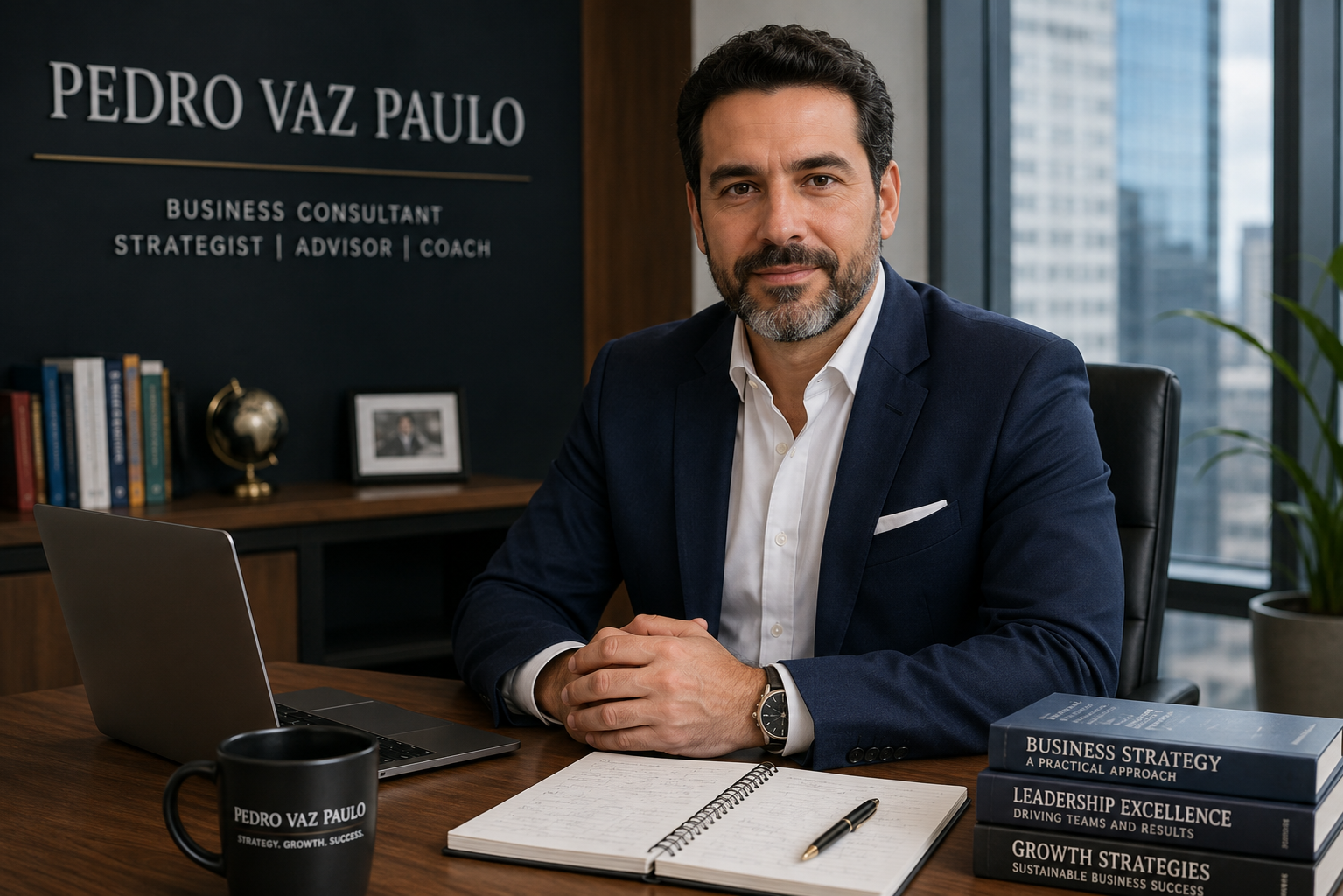
When people search for Pedro Vaz Paulo, they may be looking for several different things at once. Some want to know who Pedro Vaz Paulo is, others are interested in his work as a business consultant, and some simply want to understand why the name appears across websites discussing entrepreneurship, leadership, strategy, and business growth. The search can become confusing because several websites publish information about Pedro Vaz Paulo, while the available public profiles do not always agree on every biographical detail.
The most consistent theme across these online profiles is business consulting. Pedro Vaz Paulo is presented online as a consultant, strategist, and advisor whose work focuses on helping businesses deal with growth, leadership, operations, strategy, and organizational challenges. Several sites also associate the name with executive coaching and entrepreneurial guidance. However, readers should separate descriptions published by consulting websites from independently verified biographical information. That distinction matters whenever someone is researching a professional figure primarily through online sources.
This article takes a practical approach to the topic. Instead of turning every online claim into a fact, it examines the professional identity associated with Pedro Vaz Paulo, the consulting ideas connected with the name, the services described by his websites, and the broader lessons that can be drawn from that business philosophy. Whether you’re researching him for general knowledge, considering consulting services, or simply trying to understand the search term, this guide gives you a clearer starting point.
Who Is Pedro Vaz Paulo?
Pedro Vaz Paulo is presented on several websites as a business consultant and strategic advisor. His online professional presence focuses heavily on helping organizations and entrepreneurs understand their business challenges, develop strategies, improve operations, and pursue sustainable growth. One official-style profile says the consulting practice was established in 2008 with the goal of helping companies find a path toward business success. Another website gives a different founding year, which is one reason readers should be careful when treating individual biographical claims as confirmed facts.
The professional image associated with Pedro Vaz Paulo is broader than that of a traditional consultant who simply produces reports. His websites describe an approach involving strategy, implementation, leadership development, operational improvement, and practical problem-solving. In other words, the central idea is that business advice should eventually translate into action. A strategy can look impressive on paper and still fail if employees cannot execute it, customers do not respond to it, or the company’s financial resources cannot support it.
Another interesting part of the Pedro Vaz Paulo search landscape is the number of websites using similar branding. There are multiple domains that describe consulting, coaching, entrepreneurship, investment, or strategic services under the Pedro Vaz Paulo name. Some appear closely connected, while others have different descriptions and claims. This means that anyone researching the individual should look at the source of each statement instead of assuming that every website using the same name represents one verified corporate history. That is particularly important when researching career history, education, awards, client numbers, or financial achievements.
The Professional Identity Associated With Pedro Vaz Paulo
A strong professional identity is built around more than a job title. In consulting, it includes the problems a person solves, the clients they serve, the methods they use, and the results they aim to produce. Online profiles associated with Pedro Vaz Paulo consistently position him around these ideas. The common description is someone who works with businesses that need greater clarity, stronger systems, improved execution, or a more structured approach to growth.
This positioning makes sense in a modern business environment where owners and executives often face several challenges at the same time. A company may have a good product but weak marketing. Another may have strong sales but poor operational systems. A third may have talented employees but unclear leadership. A consultant can potentially help connect these separate problems instead of treating each one as an isolated issue.
The online material also emphasizes customized advice. Rather than suggesting that every business should follow the same formula, the consulting profiles associated with Pedro Vaz Paulo describe a process based on understanding the individual organization’s situation before recommending solutions. That is an important principle in professional consulting because businesses differ in size, industry, customer base, resources, culture, and competitive environment. A strategy that works beautifully for one company may be completely inappropriate for another.
Pedro Vaz Paulo and Business Consulting
Business consulting is essentially structured problem-solving. A consultant studies a company’s current situation, identifies weaknesses or opportunities, develops possible solutions, and helps management decide what should happen next. Depending on the assignment, this can involve strategy, finance, operations, technology, human resources, marketing, or leadership.
The websites associated with Pedro Vaz Paulo describe a similarly broad consulting model. Services mentioned online include business strategy, financial consulting, human resource consulting, IT consulting, operations, marketing, leadership development, and executive coaching. The exact list varies by website, but the common thread is a focus on improving the way a business operates and grows.
One reason this type of consulting attracts business owners is that internal teams can sometimes become too close to their own problems. When people work inside the same organization every day, certain inefficiencies can become normal. An outside advisor may notice unnecessary processes, unclear responsibilities, weak performance measurements, or missed opportunities that employees have stopped questioning. Good consulting is therefore not about telling a company what it wants to hear. It is about identifying what the business actually needs to address.
The Importance of Strategy in the Pedro Vaz Paulo Approach
Strategy is one of the most frequently mentioned areas in the online material associated with Pedro Vaz Paulo. In simple terms, business strategy answers questions such as where a company wants to go, which customers it wants to serve, what advantages it can build, and how it will allocate limited resources.
A useful strategy should be realistic. It’s easy for a business plan to contain impressive phrases such as “become a market leader” or “expand globally.” The difficult part is deciding what the company will actually do next week, next month, and next year to move toward those goals. A practical strategy connects ambition with resources, timelines, responsibilities, and measurable outcomes.
The consulting philosophy described on Pedro Vaz Paulo websites appears to favor this connection between strategic thinking and execution. One profile emphasizes working alongside clients rather than relying on generic advice. Another describes a process involving clarification, execution, optimization, and sustainable scaling. This is an important distinction because strategy without implementation often becomes nothing more than a document stored on a computer.
Leadership Development and Executive Coaching
Leadership is another major theme associated with Pedro Vaz Paulo. Business performance is not determined only by products, technology, or financial resources. People make decisions, manage teams, communicate priorities, resolve conflicts, and establish organizational culture. As a result, leadership quality can have a major influence on how effectively a company executes its plans.
The consulting profiles describe leadership development as a way to improve managerial confidence, decision-making, communication, and effectiveness. Executive coaching takes a slightly different approach from traditional consulting. Instead of focusing entirely on the organization, coaching can focus more directly on the individual leader and their habits, decisions, strengths, weaknesses, and professional goals.
Good leadership coaching should not be confused with motivational speaking. Motivation may create a temporary emotional boost, but sustainable leadership development requires repeated practice. Leaders need to learn how to delegate, communicate difficult decisions, give useful feedback, manage priorities, and create accountability. Those skills develop through experience and reflection rather than through inspirational slogans alone.
How Operations Fit Into the Pedro Vaz Paulo Business Model
Operations are where strategy becomes reality. A company can have an excellent marketing campaign and still disappoint customers if orders are processed slowly. It can have a great product and still lose money if production costs are uncontrolled. It can hire talented employees and still experience chaos if responsibilities are unclear.
Online profiles connected with Pedro Vaz Paulo emphasize operational improvement as part of the consulting process. The focus includes identifying inefficiencies, improving processes, measuring performance, and building systems that can support growth.
This is especially important when a small business begins to grow. At the beginning, an owner might personally handle sales, customer service, purchasing, bookkeeping, and scheduling. That can work when there are only a few customers. Eventually, however, the same informal system becomes a bottleneck. Growth requires repeatable processes so that the company does not depend entirely on one person’s memory or energy.
A practical operations review might examine questions such as:
- Where are customers waiting unnecessarily?
- Which tasks are repeated by multiple employees?
- Which processes depend on one person?
- What information is missing when decisions are made?
- Which expenses are growing faster than revenue?
- Which performance indicators actually matter?
- Where are customers experiencing friction?
These questions are simple, but they can reveal problems that are surprisingly expensive.
Financial Consulting and Smarter Resource Management
Money is another important part of business decision-making. A company can generate strong sales and still experience financial pressure if expenses, cash flow, debt, or working capital are poorly managed. For this reason, financial consulting appears among the services listed by several Pedro Vaz Paulo-related websites.
Financial strategy does not necessarily mean complex investment theory. For many small and medium-sized businesses, it begins with understanding basic numbers. Owners need to know how much revenue they generate, how much it costs to deliver their products or services, what their fixed expenses are, how quickly customers pay, and how much cash is available to cover upcoming obligations.
A consultant can help organize these numbers into a clearer decision-making framework. Instead of asking, “Are sales increasing?” management can ask better questions: Are profitable sales increasing? Is customer acquisition becoming more expensive? Are margins improving? Is cash flow keeping pace with growth? Are new investments producing measurable returns?
That distinction is crucial. Revenue is not the same as profit, and profit is not the same as cash in the bank.
Technology and Digital Transformation
Technology has changed the way companies operate, and consulting has changed with it. Modern businesses often depend on cloud software, customer relationship management systems, data analytics, automation, cybersecurity, artificial intelligence, and digital marketing. Several websites associated with Pedro Vaz Paulo include IT or digital transformation among their consulting areas.
However, technology should not be adopted simply because it is fashionable. The real question is whether a tool solves a meaningful business problem. Automating a broken process may simply make the wrong process happen faster. Buying expensive software without training employees can create frustration rather than efficiency.
A thoughtful digital transformation begins with business objectives. If the objective is to reduce customer response time, management should identify where delays occur before selecting software. If the goal is better financial reporting, the company should first decide which information it actually needs. Technology should support the strategy instead of becoming the strategy.
This principle is particularly relevant to small businesses. They often have fewer resources than large corporations, so every technology investment needs to justify itself. The best solution is not necessarily the most sophisticated one. Sometimes a simple, well-used system is far more valuable than an advanced platform that employees barely understand.
Entrepreneurship and Startup Guidance
Entrepreneurship is another major topic connected with Pedro Vaz Paulo online. Websites using the name describe support for founders, startups, entrepreneurs, and growing businesses. The services described include business-model clarification, market validation, positioning, launch planning, founder coaching, accountability, and execution support.
Startups face a unique problem: they are often trying to make decisions with limited information. A founder may have a promising idea but no proof that enough customers will pay for it. Spending too much money before testing demand can be dangerous. This is why market validation is an important part of responsible entrepreneurship.
Validation can involve interviews, surveys, prototype testing, landing pages, small pilot programs, pre-orders, or other controlled experiments. The purpose is not to prove that the founder is right. The purpose is to discover whether the market agrees with the founder’s assumptions.
A useful entrepreneurial mindset therefore combines optimism with skepticism. Entrepreneurs need enough confidence to act, but enough humility to change direction when evidence shows that their original plan is not working.
Building a Growth Roadmap
Growth sounds exciting, but uncontrolled growth can create serious problems. A company that doubles its customer base without improving its systems may become slower, less reliable, and more expensive to operate. Sustainable growth requires preparation.
The consulting philosophy described on Pedro Vaz Paulo-related sites emphasizes structured growth rather than growth for its own sake. One profile describes a process that begins with clarification and alignment, moves into execution and optimization, and then focuses on sustaining and scaling the business.
A growth roadmap can include several components. First comes the business objective. Next comes the current-state assessment. After that, the company identifies the biggest constraints preventing progress. Those constraints become priorities. Finally, management establishes measurable targets and assigns responsibility for execution.
For example, a company may discover that its biggest problem is not a lack of customers but a lack of delivery capacity. In that situation, spending more money on advertising could actually make the business worse. The better investment might be hiring, training, automation, inventory management, or supplier diversification.
That is why good strategy begins with diagnosis.
The Role of Customized Consulting
One of the strongest themes across the Pedro Vaz Paulo websites is customization. The idea is that consulting should begin by understanding the client’s specific circumstances rather than immediately applying a standard template.
Customization matters because businesses operate in different environments. A local retail store, a technology startup, a professional services firm, and a manufacturing company may all want growth, but the meaning of growth is different for each one. Their cost structures, customers, regulations, technology needs, and competitive pressures can be completely different.
A customized consulting process might begin with interviews and data analysis. The consultant could review financial statements, sales performance, customer feedback, operational workflows, organizational structure, and competitive conditions. The goal is to develop a more accurate picture before recommending changes.
This approach also helps prevent a common consulting mistake: solving the wrong problem. A business owner may believe that marketing is the issue because sales are weak. A deeper analysis could reveal that customers are interested but abandon purchases because the ordering process is complicated. Without diagnosis, the company might spend heavily on advertising while leaving the real problem untouched.
Why Execution Matters More Than Ideas Alone
Business is full of ideas. The difficult part is execution.
Almost every entrepreneur can create a list of things the company should improve. The challenge is deciding which improvements matter most and making them happen consistently. This is why the online Pedro Vaz Paulo profiles repeatedly emphasize practical execution alongside strategy.
Execution requires ownership. Someone must be responsible for each important task. There should be a deadline, a measurable result, and a way to determine whether the work succeeded. Without those elements, strategic initiatives can quietly disappear as employees return to their daily routines.
A strong execution system can be surprisingly simple. A company might maintain a weekly priority list, a small set of key performance indicators, and regular leadership meetings. The goal is not to create endless bureaucracy. The goal is to make important work visible and accountable.
The same principle applies to personal development. A leader who decides to become a better communicator needs more than the intention to improve. They might need to practice structured meetings, request feedback, document decisions, and review outcomes. Progress becomes easier to see when behavior is measurable.
Pedro Vaz Paulo and the Idea of Sustainable Growth
Sustainable growth is different from rapid expansion. Rapid growth focuses heavily on speed, while sustainable growth considers whether the organization can continue performing effectively as it becomes larger.
This concept is particularly important because growth increases complexity. More customers mean more support requests. More employees mean more communication requirements. More products mean more inventory and operational decisions. More markets mean more competition and potentially more regulatory requirements.
The online consulting profiles associated with Pedro Vaz Paulo frequently use terms such as sustainable growth, long-term success, measurable results, and lasting change. These concepts suggest a business philosophy in which the quality of growth matters as much as the quantity of growth.
A sustainable company should ideally have systems that can handle increasing demand without requiring the founder to personally solve every problem. It should have financial visibility, reliable processes, capable managers, and a clear understanding of its customers.
Growth should make the organization stronger, not simply bigger.
What Makes a Good Business Consultant?
Looking at the Pedro Vaz Paulo topic also raises a broader question: what should people expect from a good business consultant?
First, a consultant should listen. It sounds obvious, but it is surprisingly important. A consultant who arrives with a predetermined answer may miss the actual problem. Listening allows the advisor to understand the organization’s culture, constraints, history, and goals.
Second, a consultant should be able to explain complex ideas clearly. Business owners do not need impressive terminology for its own sake. They need to understand what is wrong, why it matters, what can be changed, and what the change will require.
Third, a consultant should understand the difference between recommendations and results. A recommendation is only a proposed action. The real value appears when the organization successfully implements it and produces a meaningful improvement.
Finally, consultants should be transparent about evidence. This is particularly important when researching professionals online. Readers should distinguish between information published by a consultant’s own website, third-party descriptions, testimonials, and independently verified records.
Understanding the Different Pedro Vaz Paulo Websites
Anyone researching Pedro Vaz Paulo may notice several websites with similar names. Some present themselves as consulting businesses, while others publish articles, coaching material, entrepreneurship guidance, or investment-related information. This can make the online identity difficult to interpret at first glance.
For example, one site says its consulting firm began in 2008, while another says the business was founded in 2010. Some profiles describe a wide range of services, including strategy, IT, operations, finance, marketing, leadership, and coaching. Other sites focus more heavily on entrepreneurship or executive development.
This does not automatically mean that every website is fraudulent or unrelated. It simply means that researchers should verify the relationship between websites before treating them as one authoritative source. Online branding can spread across domains, and different websites may be created at different times for different purposes.
The safest approach is to use first-party pages for understanding how the individual or organization describes itself, then use independent sources for claims that require external confirmation. This method is useful when researching almost any professional figure.
Public Information and the Importance of Verification
There is an important difference between “a website says something” and “the statement has been independently verified.”
Several third-party pages describe Pedro Vaz Paulo as a consultant, strategist, coach, or business advisor. Some make broad claims about experience, global clients, education, achievements, or professional recognition. However, those claims should be treated carefully when the source does not provide independent evidence. One recent review of the online footprint specifically notes that the available material includes a mixture of self-presentation, promotional content, third-party coverage, and ambiguity.
That does not make the professional identity meaningless. It simply affects how confidently individual claims should be presented.
For readers, the lesson is straightforward: check the source, date, wording, and evidence behind important claims. If a biography says someone has a particular degree, look for an independent professional profile or institutional record when possible. If a website claims major clients or awards, look for confirmation from the organizations involved. If a site claims a specific founding date, compare it with archived or official corporate information.
Good research is not about being suspicious of everything. It is about matching confidence to evidence.
Pedro Vaz Paulo as an Online Search Topic
The keyword Pedro Vaz Paulo has become interesting from an SEO perspective because the search results contain multiple overlapping interpretations. A person searching the name might be looking for a biography, consulting services, business advice, entrepreneurship content, or general information.
This creates an unusual content challenge. A useful article cannot simply repeat the same short biography. It needs to explain why the name appears online, what professional areas are associated with it, and where information remains uncertain.
Search engines increasingly reward useful content rather than pages created only to repeat keywords. That means an article about Pedro Vaz Paulo should naturally answer the questions a real reader has. Who is he? What does he do? What services are associated with the name? What is the consulting philosophy? What should readers verify?
This approach also makes the article more useful to humans. Instead of stuffing the keyword into every paragraph, the writer can use related phrases such as business consulting, strategic planning, executive coaching, entrepreneurship, operational improvement, leadership development, business growth, and digital transformation.
Lessons Entrepreneurs Can Take From This Business Philosophy
Even readers who have never heard of Pedro Vaz Paulo can take useful lessons from the consulting ideas associated with the name.
The first lesson is to define the problem before choosing the solution. Entrepreneurs often rush toward tools, advertisements, hiring, or technology because action feels productive. But action without diagnosis can waste resources.
The second lesson is to connect strategy with execution. A company should know not only what it wants to achieve but also who will do the work, when it will happen, how progress will be measured, and what resources are required.
The third lesson is to build systems before growth makes them necessary. If a company waits until it is overwhelmed to improve its processes, the transition can become painful. Simple documentation, clear responsibilities, and useful performance metrics can create a stronger foundation.
The fourth lesson is to treat leadership as a business skill. Strategy and technology matter, but people still make decisions. Strong leadership can help organizations adapt when conditions change.
Why Customized Strategy Can Beat Generic Advice
Generic business advice can be useful as an introduction, but it has limits. Statements such as “increase marketing,” “reduce costs,” or “hire better employees” sound sensible, yet they do not explain what a particular company should actually do.
A customized strategy begins with context. What is the company selling? Who buys it? Why do customers choose it? What does it cost to deliver? What are competitors doing? Where does the company have an advantage? Where is it vulnerable?
Once those questions are answered, recommendations become more specific. A consultant might determine that the company does not need more leads but needs better lead qualification. Another company may need fewer products rather than more products. A third may need to improve employee training before expanding.
The value of consulting therefore comes partly from specificity. The goal is not to produce advice that sounds good in every situation. The goal is to produce advice that makes sense for this situation.
How Business Leaders Can Measure Results
Measurement is essential if a company wants to know whether a strategy is working. Without metrics, managers can easily confuse activity with progress.
Useful metrics depend on the business. A subscription company may monitor retention and customer lifetime value. A retailer may focus on conversion rate, average transaction value, inventory turnover, and gross margin. A consulting company may track utilization, project profitability, client retention, and sales pipeline.
The important point is that measurement should connect to objectives. Tracking dozens of numbers can create confusion. A smaller group of meaningful indicators is usually easier to manage.
This fits naturally with the results-oriented consulting philosophy described across Pedro Vaz Paulo’s online profiles. Several pages emphasize measurable outcomes and performance improvement rather than advice for its own sake.
The Human Side of Business Transformation
Business transformation is often described in terms of technology, systems, and strategy. Yet transformation is ultimately carried out by people.
Employees need to understand why a change is happening. Managers need to know what their responsibilities are. Customers need to see the value of the new approach. Leaders need to maintain momentum when the initial excitement disappears.
This is why communication matters so much. Even a technically excellent strategy can fail if employees do not understand it. A company changing its customer-service process, for example, should explain the reason for the change, provide training, gather feedback, and measure results.
Leadership development becomes important here because executives are responsible for creating the conditions in which change can succeed. A consultant can recommend a new process, but the organization’s leaders must help people adopt it.
The Future of Business Consulting
The consulting industry itself is changing. Artificial intelligence, automation, remote work, analytics, and increasingly accessible digital tools mean businesses can solve some problems internally that previously required outside specialists.
At the same time, complexity is increasing. Companies now have more data, more software, more communication channels, and more strategic options than ever. Having information is not the same as knowing what to do with it.
This creates an opportunity for consultants who can combine human judgment with technology. The future consultant may spend less time collecting basic information and more time interpreting it, challenging assumptions, designing strategies, coaching leaders, and helping teams execute.
The themes associated with Pedro Vaz Paulo—strategy, leadership, operations, technology, entrepreneurship, and sustainable growth—fit naturally into this changing environment. Whether consulting is delivered traditionally or through increasingly digital methods, the fundamental challenge remains the same: helping organizations make better decisions and turn those decisions into results.
What Readers Should Know Before Hiring Any Consultant
Anyone considering a consultant should do more research than simply reading a professional website. A polished website can explain services, but it does not automatically prove effectiveness.
Potential clients should ask about experience relevant to their particular industry or problem. They should ask what the engagement includes, how progress will be measured, how communication will work, and what the expected deliverables are.
It is also useful to understand the difference between coaching and consulting. Coaching often focuses on helping an individual think through decisions and develop capabilities. Consulting typically involves analyzing a business problem and recommending or implementing solutions. Some professionals offer both, but the client should understand what they are purchasing.
Most importantly, avoid unrealistic promises. Business growth is affected by many variables, including market conditions, customer behavior, competition, financial resources, and execution. A responsible professional should explain opportunities and risks rather than guarantee outcomes that cannot reasonably be guaranteed.
Pedro Vaz Paulo and the Value of Practical Business Thinking
The most useful way to understand the professional identity associated with Pedro Vaz Paulo is through the recurring themes found across his online presence: business strategy, consulting, leadership, operational improvement, entrepreneurship, and sustainable growth.
The strongest message running through these themes is practical thinking. Businesses do not improve simply because someone writes a strategy document. They improve when leaders identify the right priorities, employees understand what needs to happen, systems support the work, and results are measured.
That principle applies whether the organization is a startup with three employees or an established company with hundreds of workers. The scale changes, but the fundamentals remain surprisingly similar.
A business needs direction. It needs capable people. It needs processes. It needs financial discipline. It needs customers. And it needs the ability to learn when circumstances change.
Common Questions About Pedro Vaz Paulo
Who is Pedro Vaz Paulo?
Pedro Vaz Paulo is presented across several websites as a business consultant, strategist, and advisor. Online profiles associate the name with business consulting, leadership development, entrepreneurship, operations, strategy, and related professional services. Because different websites provide different biographical details, readers should verify specific claims against reliable sources rather than assuming every published detail is independently confirmed.
What does Pedro Vaz Paulo do?
The websites associated with Pedro Vaz Paulo describe services including business consulting, strategic planning, leadership development, executive coaching, operations improvement, financial consulting, IT consulting, marketing, and entrepreneurial support. The exact service list varies between websites, so it is sensible to check the specific consulting site for current offerings.
Is Pedro Vaz Paulo a business consultant?
Yes, the professional websites using the Pedro Vaz Paulo name consistently present him or the associated practice as a business consultant. The consulting focus includes helping companies improve strategy, operations, leadership, and growth.
Does Pedro Vaz Paulo work with entrepreneurs?
Entrepreneurship is one of the areas associated with the Pedro Vaz Paulo online presence. One website specifically describes founder coaching, market validation, business positioning, launch planning, accountability, and startup execution support.
What is Pedro Vaz Paulo’s consulting philosophy?
The recurring philosophy across the available websites is customized, practical, results-oriented consulting. The emphasis is on understanding an organization’s situation, developing a tailored strategy, implementing improvements, and measuring progress rather than relying only on generic recommendations.
Is all information online about Pedro Vaz Paulo verified?
No. Public information varies between websites, and some third-party articles repeat claims that originate from promotional or self-published sources. For that reason, important biographical claims should be independently checked before being treated as established facts.
What industries does Pedro Vaz Paulo work with?
Online consulting profiles describe work across different business areas and mention clients such as startups, entrepreneurs, growing businesses, and leadership teams. Some pages also mention industries including technology, retail, consulting, and real estate.
Does Pedro Vaz Paulo provide executive coaching?
Executive coaching is listed among the services associated with PedroVazPaulo.com. The broader consulting material describes leadership development and coaching as ways to help leaders strengthen decision-making, performance, communication, and other professional capabilities.
Why is the name Pedro Vaz Paulo appearing on many websites?
The name appears across multiple websites focused on consulting, entrepreneurship, leadership, business education, and related subjects. Some websites appear to present consulting practices, while others publish informational content. Because the online footprint is fragmented, readers should examine individual domains and sources rather than assuming every page has the same ownership or authority.
Conclusion
Pedro Vaz Paulo is an increasingly searchable name within online business and consulting content. The professional identity most consistently associated with the name is that of a business consultant and strategic advisor focused on helping organizations and entrepreneurs address challenges involving strategy, leadership, operations, technology, and growth.
At the same time, the online record deserves careful reading. Different websites provide different details about the professional history, founding dates, services, and background connected with Pedro Vaz Paulo. That makes source evaluation especially important. Readers should distinguish between first-party descriptions, third-party articles, testimonials, and independently verified information.
From a business perspective, however, the themes associated with Pedro Vaz Paulo offer useful lessons regardless of where someone stands on the broader biography. Successful businesses need more than ambitious ideas. They need clear strategy, capable leadership, efficient operations, financial discipline, technology that solves real problems, and systems that can support sustainable growth.
That is ultimately the most practical takeaway from researching Pedro Vaz Paulo. The strongest business strategy is not necessarily the most complicated one. It is the one that clearly identifies the problem, chooses a realistic direction, gives people the tools to execute it, and measures whether the effort is producing meaningful results.
you also may read
pedro vaz paulo











Leave a Reply